Tuesday, March 19, 2024

TV Show: Armchair Detectives

          Here I am lying in bed as I am typing this. I am sick. I got the chills and fever yesterday. My throat is sore and it hurts, plus I developed a cold (clogged nose). I'm taking antibiotics today and paracetamol. I just finished watching Netflix's Irish Wish, it is a cute rom-com played by Lindsay Lohan. She is a popular American actress who played the lead in "Mean Girls" movie.


Anyway, checking my Amazon Prime. I bumped into this cool tv series, hosted by Susan Calman. It is called, "Armchair Detectives". Its a cool tv series because you get to solve the mystery of who is the culprit. I read that they based this on the "Cluedo," "Sleuth 101" and "Whodunit". I got hooked immediately and I tried solving it. I just had a hard time understanding what was being said because British English is quite different from American English, the way they pronounce and say sentences and words. British accent is more close with Australian accent. I am a lover of British culture and an Anglophile. Someday I wish to visit the birth place of Jane Austen and Agatha Christie, my favorite writers. 

If you enjoy mystery/crime tv shows and series, you better check this out, and let yourself be involved in solving the mystery! 

Sunday, March 3, 2024

Movie Review: See How They Run

         I just finished watching this movie today.

This movie mentions our favorite queen of mystery writer, Agatha Christie's long-running play, The Mousetrap. This is available on Disney channel, Philippines.

Spoilers ahead! So the movie is about this director who got killed while in a celebratory party for the musical play, The Mousetrap. In the movie there was a plan of making it in a film. Enter these two inspector from the Scotland Yard, a young rookie one, Constable Stalker and senior Inspector Stoppard. 

I kinda find this movie dragging. I started watching this weeks ago and its only now that I have finished it. I learned that this was based upon two young boys who were maltreated by their foster parents and one of that boy died (real life person named, + Dennis O' Neill) due to physical abuse. I have not seen or read this play. The Three Blind Mice is the novel form, and The Mousetrap is the play script of it. I also didn't like their portrayal of Agatha Christie. Well, this is my opinion only, we are all entitled to our own opinion right?! If you have not seen the movie try watching and write me a comment of your thoughts about it. Okay?!


TV Series Review: Only Murders in the Building

           I am currently subscribed to Disney channel in my cellphone application. I have decided to subscribe because, "See How They Run," is the movie adaptation of Agatha Christie's novel, "The Mousetrap." 

I have read that, "The Mousetrap" is the world's longest running play. So I am itching again to have a copy of her book. This Disney tv series stars, Pop Princess and former tv series princess, Selena Gomez and tv movie and veteran actors Martin Short and Steve Martin. In Season 3, Meryl Streep was included in the cast. In less than one week I have finished this tv series and I absolutely love it. Even if crime and murder is really scary, I was not really scared at all. What I felt in this movie is like a cozy feeling at home. Watching the trio solve a crime and just being best pals with each other gave me comfort, and I must say this tv series is one happy pill for me! I love Steve Martin's portrayal of a "has been" action tv series star, as Charles Haden Savage, and Martin Short as Oliver, a former director of theater plays and lastly Selena plays the Mabel, the mysterious beautiful neighbor (in Season 1). This was set in a beautiful building called the Arconia in New York.

Spoilers coming! Season 1 is about the trio uncovering the murder Tim Kono, a tenant in the Arconia. Season 2 is about Mabel being suspected as the killer of Bunny, the building president and Season 3, who is the killer of the lead star in Oliver's directorial play again. If you have not seen the series I suggest you do! It is so funnily entertaining! Can' t wait for season 4. The double of Charles Haden Savage was shot.

Saturday, March 2, 2024

Agatha: The Real Life of Agatha Christie


  I'm back with another Agatha Christie book. This time it is an illustrated one. On the back page of the book. Ms. Christie was described by the following words, novelist, wife, nurse, tourist, mother, archaeologist, playwright and dame. Dame is the honorary title given to her. The price of this illustrated or I would like to call it as a comic book is $19.95 as shown at the back cover. 


The authors of the book is a trio. If I am not mistaken, they are all French. I like the illustration, the way it was drawn like a classic cartoon from a Sunday newspaper. Check out the photo here. If reading her biography is too taxing for you then I suggest you grab a copy of this. This may not be as comprehensive as the one written by Lucy Worsley but you can pick up some idea about her life is. This book is also an ideal gift to give to an avid Agatha Christie fan. Books became even more interesting because of her. Don't forget that she is the most widely read mystery author for many years now and as the same popularity with Shakespeare and the Bible! 


Tuesday, February 27, 2024

Another Agatha Christie Book


 I got another book by Ms. Agatha Christie, it is February now and the Holiday season is still faraway, but I got this book! Actually, I have not read "The Secret Adversary," and I still bought another book. I still have one more book that I am waiting for. Mystery novels are really good. This kind of read really makes your day less boring. I'm happily adding this to my AC (Agatha Christie) book collection! Read on!

Saturday, February 24, 2024

More Agatha Christie Books


 I have seen the Wonka movie that was shown December 2023. It was entertaining indeed. So I got hooked into it for awhile. I suddenly missed my mystery and crime side. Again, I bought two books. I got a bargain, "The Secret Adversary," from Agatha Christie collection. It is a hard bound copy with a magazine. This book was very timely since the group of "Read Christie Challenge 2024", this is their book of the month.  The people of Agatha Christie Ltd suggested that challenge. I asked the team if they can send me a photo with a handwritten signature of Agatha Christie's grandson. They were not able to grant my request but instead they said that they just can send me postcards.I am eagerly awaiting it. 

I also bought the life story of Agatha Christie by British Historian Lucy Worsley. Both books are expensive but I know its worth it. Even if the period when she wrote these stories are really far from the modern world today, I still love the feeling that it gives me. I got this one from my favorite bookstore, Fully Booked. So that's all for now, while I relax and continue reading one of Ms. Christie's book, while having my cup of tea.


Friday, April 1, 2022

Beatrix Potter, The Creator of Peter Rabbit

             This pandemic, I have immersed myself in arts. Mostly drawing, coloring with colored pencils and watercolor. I recently re-watched Miss Potter (2006) movie starring Renee Zellweger, and I have seen a classic movie about her life, "Beatrix: The Early Life of Beatrix Potter", starring Helena Bonham Carter as Beatrix Potter. I am also enjoying watching the old classic cartoon, "The World of Peter Rabbit and Friends". I also bought a few Beatrix Potter/Peter Rabbit memorabilias online. But I did not splurge much, because my husband is telling me to be careful in spending money especially during this time of pandemic. I am presently enjoying re-creating Beatrix Potter's characters like Peter Rabbit and the mice from the "Tailor of Gloucester". 


Though Beatrix Potter's stories are written mainly for children, it is also entertaining for us adults. Her stories are not boring, and the message from her stories is not really shallow. I also love her artworks. From her book by Elizabeth Buchan. We can see at an early age she showed her potential, she draws animals like insects, caterpillars etc. in a detailed way and she draws them very well. 

The book that I bought is only the lone one available. I was blessed because its price was already marked down. The book is hardcover, and the pages were all very good, it is glossy and it contains photos. So its not boring at all to read. I was able to finish it for 2 days.

Beatrix and her brother Bertram loved to draw and paint, they have many sketches of their pets ranging from rabbits, mice, frogs lizards and bats. What I like about her is that she followed her heart, and not anyone when it comes to pursuing what she wants in her life. The first artwork that I did was Peter Rabbit which Beatrix Potter was really known for. She is considered as a mycologist (someone who works with fungi), in her young adult years she met and collaborated with Charles Macintosh, a musician and also known as a "Pertshire Naturalist". You can see Beatrix Potter's beautiful and detailed works as per the advice of Sir Macintosh who encouraged her to  make her drawings even more detailed. Thus, she began using watercolors. Her work was rejected by the Linnean society (which was obviously a sexist). In those days, women didn't go to school, Beatrix was tutored by a governess. During her time formal education was inaccessible for women. Perth museum and art gallery has a collection of her works. If she wasn't rejected, we wouldn't have "Peter Rabbit" today. So look for the silver lining in everything. 

The man who helped her and was instrumental for her success, Norman Warren was also her first love, and became engaged but unfortunately no wedding happened because Norman got sick and died. She later on got married to a lawyer named William Heelis. Beatrix has no children. She lived on happily in her old age together with her husband in a farm she bought. 


Her best known books for the children's were tales of "The World of Peter Rabbit and Friends", are 23 all in all. Her unpublished book, "The Tale of Kitty in Boots", with illustrations by Quentin Blake was a bestseller again, and was published on September 1, 2016, to mark her 150th anniversary of her birth. She wrote 10 other books which includes a coloring book, painting books and an almanac. In 1936, Beatrix flatly declined Walt Disney's offer to make an animation of Peter Rabbit. So critics were saying that the modern adaptation by Sony of her character Peter Rabbit wouldn't make Beatrix happy, and she would disagree with it. It is not because she was possessive of her works but because she has a clear idea in her head what her characters should be like. I have seen the latest Peter Rabbit film from Sony, and I can see that Peter was portrayed as a somewhat notorious bad rabbit there, which shouldn't be.

I like to imitate and copy her artworks, it is a sort of relaxation therapy for me, especially this pandemic and as my date of delivery nears (expecting my little angel to come out of this world in November!) I bought a few of her books so I can tell my baby about her and her stories. If you want a very good documentary about Beatrix Potter, I suggest you watch, Timeline World Histories Documentaries - Who Was the Real Beatrix Potter hosted by Dame Patricia Routledge. I also bought Beatrix Potter memorabilias (book and cd, plush toys Peter Rabbit and Jemima Puddle duck, cellphone case and mug). I also have an old dvd movie of Miss Potter starring Renee Zellweger.

The British people are really artistic and talented. Once I was hooked with the works of Jane Austen, C.S. Lewis, and J.R.R. Tolkien. I also like Paddington, very brilliant creator Michael Bond. What about you, who is the artist that you look up to? Let's do art, and make our world more colorful and lovable!

(This is a repost from my other blog: pilgrimsmelody.blogspot.com )

Netflix's Bridgerton Comes to New Manila

          It's been awhile since I last posted here. The latest news? No, I am not Lady Whistledown that has got all the latest and juiciest news. Sorry for the long hiatus since I just gave birth to a lovely baby girl last year, in November.


After a year, finally I was able to go out. Not that I did not leave the house ever, but we just went out usually because of work, hospital check-ups and other important errands. I was just watching something on YouTube when I saw Ivana Alawi's house tour at Villa Bridgerton. So I searched immediately as to where is the place located. It located in New Manila, Quezon City. The house was originally a mansion owned by Doña Narcisa de Leon. I booked immediately knowing the slots were limited. I was finally able to get a slot yesterday, which was a Thursday. My officemate pal accompanied me because I asked her. I just paid for the gas after, and treated her to a snack.


It was a very hot afternoon when we arrived at the Villa. At the concierge, or entrance we were asked by the staff to show our vaccination cards and of course wearing a mask is a must. Outside the villa, was the beautiful design of Netflix Bridgerton. We immediately went inside because of the sweltering heat. There were already a number of people inside taking photos and recording. The sala was nice with an electronic fireplace. It is also called the sitting room wherein affluent families welcome visitors, where they gather. You can also do many things in the sitting room, like read, knit/crochet, and chat with one another.

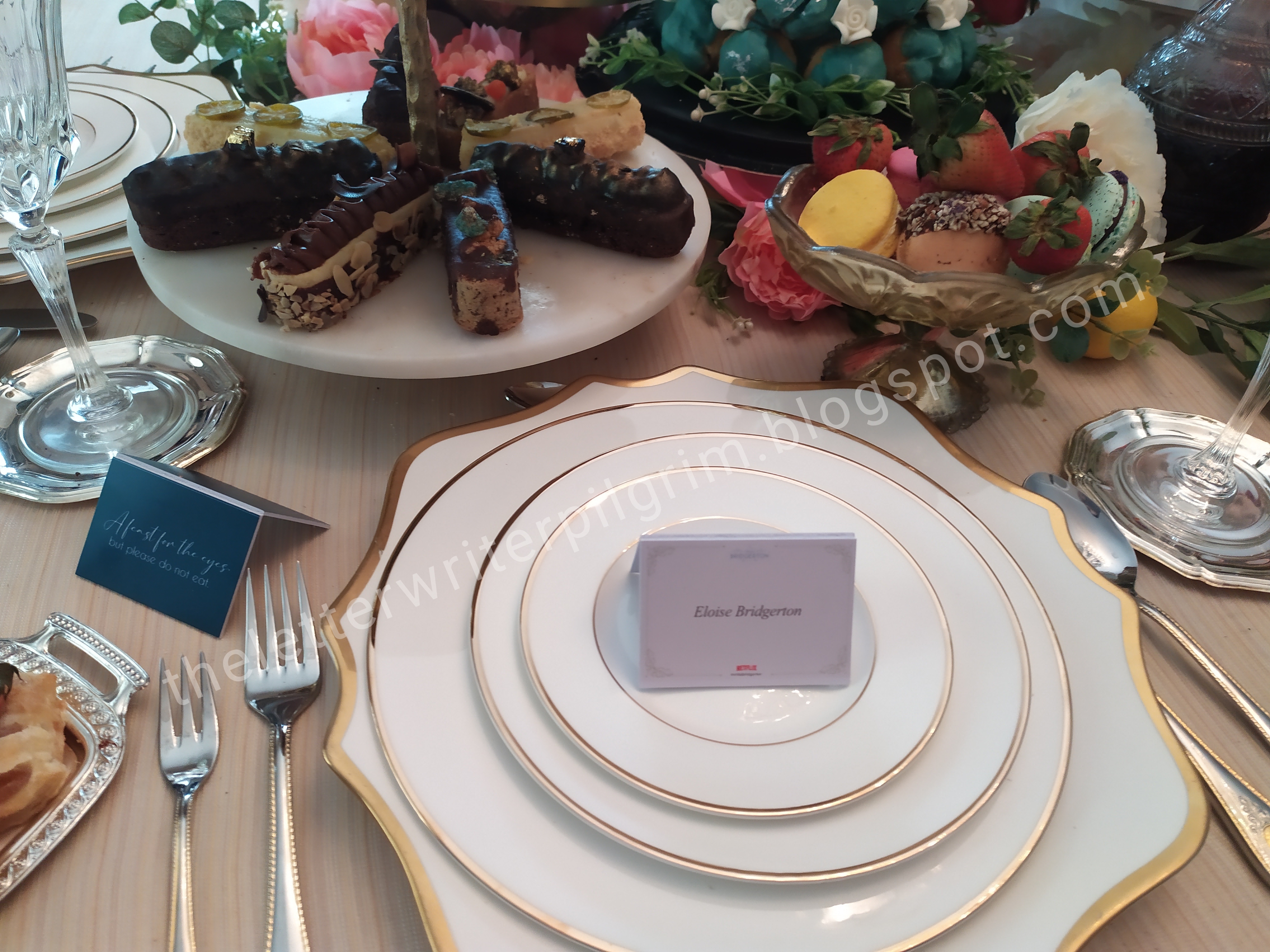
Since, I am a foodie. I immediately fell in love with the grand banquet hall. Sweets and desserts were laid on the table. I was also able to go upstairs and see one the Bridgerton's chamber. Upstairs, in the hallway you will also see life-sized portraits of the characters in Bridgerton, Season 2. The room has a vanity table, a cabinet, with a kingsize bed, and a bedside table.

We weren't able to tour the garden because for me it was too hot. So we weren't able to experience the tea party and play the outdoor game croquet. We also missed the carriage. Anyway, the experience was really fun. Even if there's still Covid virus around, that did not keep me from visiting Villa Bridgerton. The villa is open unti April 4, 2022. Slots were all booked now. You just wait for a slot to become free when a guest will cancel.  If you don't have a chance to visit the Villa. You can just watch Bridgerton, Season 2. 


Monday, January 18, 2021

My Agatha Christie Collection

          Hello everyone! Sorry for my very late post. It is 2021! Happy New Year to all of you my dear readers!

I started the year with a book haul. For those of you who are not aware, I got married already! I am officially a Mrs. this 2021. I miss buying books. As an early Vday gift and also post-holiday gift from my husband. I asked for books.


I am very much interested in mystery books right now. I just purchased this month a lot of mystery books. I purchased the popular young-adult mystery books by Karen McManus entitled, One of Us is Lying, and One of Us is Next. After that, I bought the world's best mystery writer boxed set of books, Dame Agathe Christie. I recently rented on YouTube, The Murder on the Orient Express, and it is indeed a good movie. There is an unexpected twist! No wonder Agatha Christie's books are well-loved all over the world, and it her stories are timeless. I was able to buy an original shirt of the said movie from a local specialty bookstore which is Fully Booked. I also bought online, a copy of Agatha Christie's, Evil Under The Sun illustrated version.

I am on sick leave now, and I just finished reading one of her bestselling novel, And Then There Were None. I enjoyed reading it! After maybe  a year or two of not finishing a book, I finished it, in less than 2 days! I hope to order more books from her, but of course under my husband's supervision. Because he doesn't want unwise spending of money. I will also watch the tv-movie version of this.


I also learned a lot about the detectives in her stories like Hercule Poirot, Miss Jane Marple, husband and wife duo Tommy and Tuppence, and Parker Pyne. Did you know that the first 3 detectives that I have mentioned has a tv series? The actor David Suchet played Poirot very well. The actresses who played Miss Marple are also very good in their own right.

Almost all the best things can be found in England. That is why I am fond of anything Brit. Until my next post. Thanks for visiting my blog.

Sunday, March 18, 2018

Jane Austen Society of Australia

     As I mentioned in my previous post before, I was a former member of the Jane Austen Society of Australia for a year. The reason why I joined their society, is that I wanted to belong to an organization with the same interests as mine, and it is also a status quo. To be a heralded as a true Janeite, (this is what you call followers and fans of her works). I feel that I should join their organization. I didn't renew my membership with them because, I joined another society and this time its in UK.

What I can say about JASA? (This was 2 years ago). Well, for one. Their treasurer is very accommodating, and kind. Their mode of payment is through paypal. I didn't have a paypal so I contacted them and I told them I paid via Western Union. It was really nice receiving their newsletter. As you can see, I have unopened newsletters from them. I also got my membership card wayback. The membership fee at that time was around $50.

I chose the Australia chapter because it is near to my country. If you are a Jane Austen fan, and you're from Asia, or from the Philippines. You can go to their website just click on this: -> Jane Austen Society Australia

(Note: I will just maintain one blog that is dedicated to all my interests, and hobbies. But this blog will still be open for everyone). Pls. visit my blog! Just click on this -> All Rolled Into One


Saturday, January 2, 2016

A People's History, Breakfast, Lunch's and Dinner (BBC Documentary) Pt. II

This is the part II of  A People’s History, Breakfast, Lunch and Dinner (BBC Documentary). This documentary is hosted by the late Chef and cooking show host Clarissa Dickson Wright.

I would love to share with you what I have learned in the documentary, so I will be posting all the important details that I have noted here.
-- 
Lunch for Chef Wright is the most important meal of the day. It’s the work horse meal, the one we use to refuel. But for us it’s a quick pit stop. People eat in a speedy average barely even noticing their food. She believes taking time for a decent meal. For Chef Wright we lost our relationship to our food. In the not so distant past we respected lunch like in the distant century. Chef Wright visited one last remaining authenthic chop houses, The Simpson’s Tavern, still serving traditional Victorian food. She dined together with historian A.N. Wilson. In the 19th century chop houses started. So there were more and more people crowding to into London who haven’t had breakfast, and it was a long time for dinner. They ate lamb chops with shredded cabbage as side dish, although Chef Wright preferred mutton chop.

A belly full of protein would get you through the afternoon. Victorian office workers were allocated an hour to have their lunch. Chop houses serve an ordinary or fixed price meating. Nose to tail eating was very common to cheap dishes offered. They focus on the middle-house people. Ox tail was very cheap. The specialty of the house was stewed cheese (mixed with a bit of cream, mustard and beer) it’s commonly known as Welsh rarebit. In medieval times food was preferred eaten in daylight hours. The word lunch at that time didn’t even exist, daily life revolved around the time consuming demands of hunting, cooking, and growing food. In Sussex Ms. Yeldham prepared a pottage (something cooked in a pot) selection of dishes from a typical medieval menu. All ranks of society cooks a pottage. Boiled mutton was being cooked also. People grow a range vegetable in those times, like purple carrots, white ones for animal feeds, and also they also have access to spices to flavour their food. Spices costs a fortune in those days. Medieval people love color. The popular substitute for meat is fish. The wealthy ate it fresh from rivers and fish ponds, while the poor relied on salted fish. Food was not also considered nourishment but also medicinal. They believed that bodies were composed of 4 humors, earth, air, fire and water. (yellow bile, black bile, red bile, phlegm). So a cook’s job is to provide somebody with the food that will balance their humors and bring them to perfect health.

The wealthy would enjoy eating a lot of course, but the poor only ate one dish. Medieval food is good food says Ms. Yeldham. The meal would always end with something sweet that was considered medicinal, in a way to close the stomach and aid digestion. Chef Wright was served with sweetened pears. In the early modern period of the late 17th century the Catholic scriptures were replaced by Prostestant Puritanism with the restoration of Charles II in the 1660, food became about taste and style, than balancing humors. More people are embracing city life, and new work patterns. Main meals was eaten in 11 in the morning to 2 in the afternoon. 


Samuel Pepys, a civil servant in London, and a gourmand.  Venison was the priced meat at the age. To eat deer you have to had connections. Pepys mentioned it in his diary 76 times. Ivan Day brought Pepys dish into life. 17th century people weren’t fussy eaters. Ian Day prepared a pasty, coffins or pies. Intricate designs were all the rage in Pepys time, there’s even a design for a venison pasty. In London not people had many ovens so they sent it out to be baked. People used salt and sodium nitrite (responsible for the red color of meat) to preserved meat. Garlic is not a common ingredient in the 17th century.Wealthier people would accompany their meals with salad to show off imported ingredients from afar. In Pepys time men can rise to patronage. The ever fashionable Jane Austen talked about lunch in her novel Pride and Prejudice, were the 2 sisters purchased food for luncheon. Chef Wright sat down in a luncheon table setting, consisting of  salad, slice of cucumbers and melons, dressing made of pounded hardboiled eggs (salad cream), devilled peasant legs, cold meat, and her favorite sefton of herrings (cooked in butter) invented by the Earl of Sefton he developed the recipe for his wife. Put that in a wafer biscuit, and you put cayenne pepper. Luncheon wasn’t just for high-society working people also had to eat at midday.

Victorian street food kept the poor from starving. Some portable foods have designed for specific jobs like the Cornish pasty had a crimped handle which was discarded because the miners hand might contain poisonous arsenic from tins. England’s greatest gift to convenience food is the sandwich. Lord John Montagu the 4th Earl of Sandwich, by calling for a slice of beef between two slices of bread, either he is gambling or working. A sandwich is a great invention, portable, and you can eat it very quickly. The sandwich was  invented in the 18th century.  Life for the Victorians were speeding up they have convenience food which includes potted foods as Chef Wright mentioned it is a fashionable food, and they also have rail travel. Early on street the realization dawned that his was affecting the health of the nation.


Those who volunteered for world war in the 1900’s were rejected because they were too short or were malnourished. The British empire might collapse something had to be done! In 1906, the government responded with a new law,   provision of school meal was done for the poorest children, for a proper balanced lunch. It changed the lives of millions. That a substantial meal by the middle of the day paid dividends. By the time World War II came, people were stronger. The onset of war triggered another government invention in the British diet happened and that was rationing. Rationing was introduced in January 1940. Many basic items were in very short supplies and the cues lasted for hours. Just acquiring the ingredients of a basic lunch was far more a challenge. Chef Wright visited her former school, Woldinghom school. She will deliver a ration book recipes to a class of girls. They will eat what they made after.  Most girls didn’t like the taste, but some think it was okay. Chef Wright gave a message to the students to just think back of their grandmother’s probably who were in certains situations like these during the wartime, we should gave the cooks a round of applause. Many people struggled to eat during the war. Rationing ended in 1954. A new import from overseas came not an ingredient but an idea which was the supermarket also appeared at this time, making a lunch a much easier proposition. Sliced bread first appeared in the 1920’s, the baking process in the early 1960’s devised by Britains gave bread a longer shelf life,  and so fuelled the rise of the sandwich.  Could the 4th Earl of Sandwich realized the titanic culinary legacy he left today. One if four us buy a sandwich for lunch everyday.


The popular selling line of sandwiches today are anything that has prawn or chicken. There are even awards for the most inventive sandwich fillings. His best-seller is the turkey sandwich. He designed the world most exotic sandwich. Tom Allen has won of the top prizes. Tom’s award winning sandwich is a clever take on the beef Wellington. Lunch is not just about refuelling but it’s about a relax communal experience centering on a well-cooked meal. Lunch is an important tradition because it reminds us of our old customs. Chef Wright urges everyone to take time and enjoy lunch just like our medieval ancestors.

Viscount Charles ‘Turnip’ Townshend he invented the four course rotation system (division of fields into 4 different produce). In 1752 root crops has become a part of the British’s stable diet. They ate turnips and carrots. The Georgian (18th century) dinner (high watermark of British dining) reflected a more intimated dining, and there’s a boom in decorative centrepieces, fashionable candlesticks, and the Pineapple fruit was considered a decorative emblem, a thousand pounds extravagance. If you are rich you also have a chandelier a word first recorded in England in the 1730’s. By this time the ladies were also allowed to seat down gentleman. 


By the end of the 18th century, beef was regularly included on the dinner menu. Dinner was moved forward to 8pm because of the invention of gas lamps.  Also at this time, Mrs. Isabella Beeton’s book of cookery and household management  came out. Victorians were obsessed with dinner parties. They even serve a calf’s head! The Georgian era was an age of age when it came to dinner, the service of food was evolving too.

In the later times, Fanny Cradock, she’s famous for her cooking with performance. She gave women confidence to cook. Chef Wright also visited a ready meal manufacturing company and she sampled some food there, according to her surprise she remarked that it was good, and is palatable.


Chef Wright  ends with a beautiful reminder for all of us. We now live in convenience cooking. Before dinner is associated with fashion, to show off grand clothes, embrace theatrical display. The one thing that we haven’t lost, is the common desire to enjoy good company with food. . In that it doesn’t really matter what we’re eating because every generation has its own priorities. It’s the company that matters.  In the past people devote a huge amount of time to their meals. Nowadays we’re usually too busy, and that is reflected in what, and how we eat.

But meals are not just about food. They’re social events that connects us all, and I thoroughly disapprove of families who fail to eat together. Our meals have always been movable. But the irony is that we can eat better now than at almost any other time in the past if we care to. I urge everyone to reconnect with the tradition of fresh local produce, take time to cook and eat together. Then we’ll be getting the best out of our daily meals.
---
I dedicated this post of mine to Chef Clarissa Dickson Wright, in honor of her works, she contributed a lot to the British history in Culinary. I really learned a lot from this documentary, and it made me appreciate the British Culinary History even more.


A People's History, Breakfast, Lunch's and Dinner (BBC Documentary) Pt. I

Yesterday I finished watching a British food documentary, hosted by the late chef and host of 2 Fat
Ladies, Clarissa Dickson Wright. I was looking for a good documentary about the History of British food when I stumbled upon this one.

A People’s History, Breakfast, Lunch and Dinner (BBC Documentary)

I would love to share with you what I have learned in the documentary, so I will be posting all the important details that I have noted here.

It is said that the rituals of breakfast, lunch and dinner are often taken for granted. In this documentary we will learn a lot about the gastronomical revolution, technological leaps and sometimes the gruesome with regards to meals in England. Food is just about more than filling one’s selves up.

In this documentary, Chef Wright explains the origin of the 3 main meals of the British people, namely Breakfast , Lunch and Dinner.  Firstly, we are going to talk about Breakfast. For the British, breakfast is the first meal of the day. It’s origin remains a mystery in history. The traditional breakfast (it is also the contribution of the British in the International cuisine) or the so called full English Breakfast, a quintessential morning meal. You can actually eat it and enjoy it at any time of the day. One of the popular dish is the combination of bacon and eggs. But how did it come about? Chef Wright interviewed a Dominican priest to tell of its history.


According to him, in the Middle Ages, the Catholics determine what you can eat and when. For example, it is forbidden to eat before attending a mass, you should not break your fasting. Also, during the Lenten season, and when the religious people like the monks and nuns fast, they are forbidden to eat meat, because meat is associated with the flesh and the sex. In the 13th century, Medieval restrictions is rampant. Pescatarian diet is recommended and considered virtuous. Chef Wright was offered a dish of sole fish that soaked and served with honey and mustard.  During the Lenten season there’s a single day when you can eat meat, eggs, and indulge. From the scraps of meat of pork or beef, that’s where the origin of the combination of bacon and eggs arise.

In the Medieval ages families own pigs. To preserve the meat, after butchering it they cure it. Curing is a method of preservation. The whole pig is curable. After the pork is cured it is then baked. The destitute can’t afford to buy meat. The curing of pork is the origin of bacon. Bacon became associated with breakfast in the 17th century. According to Dr. Ian Mortimer (a fellow, Royal Historal Society in the University College of London). The earliest breakfast custom is hugely divided into the society. The aristocrats do have breakfast while the poor starve to death). So breakfast is part of the aristocratic household. The more extravagant it is the better the breakfast is. As they say, “If you can afford it, you can eat well.”


Caroline Yeldham (Historian, food specialist Medieval Times), showed Ms. Wright how to cook eggs in the medieval period. They roasted  it. The first comprehensive English cookery book was by Robert May (1660). At this time they can control the temperature when they cook because they use charcoal. Ms. Yeldham made an omelette (which is an imported French dish), made with chopped ham, nuts etc. According to Chef  Wright, Robert May’s recipe version of his omelette was too elaborate to be considered as a morning dish. A physician urged restraint in the people’s diet during those times. In the Venice Medical Book, Right Way to a Long Life, obesity was first used. There’s an even recommended diet for breakfast, poached eggs with little bread and butter, and a Claret wine.

Wine and beer is the traditional dish for cooking. Coffee as a drink became popular in the 16th century. Tea which was imported from China in the 1650’s became a domestic drink, because it is easy to prepare.  Tea became a breakfast drink in the late 1740-1750’s. In the 18th century tea drinking became popular in the social circle, and became a highly fashionable activity. By the 19th century it has taken its place in breakfast.


According to Chef  Wright, in classical literature particularly in Jane Austen’s novel food was also depicted, soft boiled eggs was mentioned in Emma, while brioche was mentioned in Northanger Abbey.

In the 19th century English breakfast reached new heights. According to Christine Robinson (head housekeeper at Chatsworth), if you are a lady at those times you might prefer breakfast in bed. Breakfast is that time of the day that a lady can eat in bed. Edward VII is a frequent guest at Chatsworth. His favorite breakfast dish was hollowed onions, with chicken liver stuffings mixed with brandy and then baked. It’s a hugely indulgent breakfast. In those times, a large party consists of 2,920 hot and cold dishes. The recommended menu are as follows:

Menu:
Trout, Plovers, Eggs in Aspic
Sweet bread cutlets, Fried Filets of Sole, Coquiller of Shrimp
 Kidney Omelet, Devilled chicken, Hashed Venison, Eggs.
Kedgeree of Salmon, Broiled pigeons, Eggs and Bacon

In the 19th century, the middle-class also wanted to enjoy and experience what the Aristocrats are having. Fortnum and Mason (a sort of specialty shop) was founded by a footman in 1707. Before the customers aren’t allowed to touch the products, they can only taste it. A store staff will take note of what they wanted, and can give them advise or suggest things to them.

Marmalade brought in England in the year 1660’s by Portuguese  Princess Catherine of Braganza who became the Queen of England. The oldest marmalade was the Burlington’s breakfast marmalade. It was first made for the earl of Burlington, the recipe now was made by his chef.


The Victorian and Edwardian era, people kept adapting and inventing. Breakfast was considered as an early refinement. Chef Wright was able to try some of dishes a this time. She tried the kedgeree, which consists of rice and lentils, considered a poor man’s meal. British officer from India brought the dish to England, and they added smoked fish in it, and India the fish that they use is fresh. Kipper is a preserved salted fish.

Chef Wright also talked about another revolution in the breakfast history. The invention of the
popular American breakfast,  a household name all over the world, Kellogg’s cornflakes. Dr. Kellogg’s was a member of 7th day Adventist, and believes that God intended for us to eat vegetables, nuts and grains only. He was also the inventor of peanut butter. He invented the cereal because he believes that oatmeal is no good for him.   After tasting and getting to know the history of this popular American breakfast item, she came to the conclusion that sweetened cereals is not for her.

Having a filling breakfast put us into good mood. Nowadays, in our fast-paced time it is a luxury to have a cooked breakfast. A good breakfast comes with a cost and that is time. Lunch was a meal that didn’t exist almost 300 years ago. Dinner is a meal that clearly signals how we position ourselves to our peers. In the middle-ages dinner was done during the middle of the day where there is still light. According to Sally Dixon Smith (food historian), Ravioli started in the 14th century. No plate or cutlery existed during the middle-ages. People didn’t eat on a plate. They eat on a trencher. Dining exercises in decorum and hygiene exists, and it is not a raucous event.  Entertainment during dinner is not only expected on minstrels or court jesters, but also to medieval cooks, who only not prepared food which were feast for the eyes but also they can throw odd jokes. Liber Cure Cocorum is a book about culinary practical jokes.


According to Ivan Day (food historian), during medieval times they have limited cooking apparatus, nevertheless they can produce unique dishes. Like the mock entrails, which was called Chawdewyne De Boyce (chaudron entrails of the woods). It is made of mixed nuts, and raisins, with batter, and roasted to resemble entrails. Gluttony is a mark of aristocracy.

The Tudors (Welsh in origin), indulge themselves in sweets. They even have an area that is dedicated for making confectionary. Sweets are not for poor people because, sugar during those times are expensive. Sugar was imported from North Africa and Egypt. Painted marzipan is a popular dessert. Ellinor Fettiplace, invented the recipe for meringue, and she is a favorite of Chef Wright. In a banquet, the goodies were usually served in the end. Chef Wright was given in her honor a fondant in the shape of a shield, depicting the star sign when she was born, numbers associated with her, talents/skills and beans (which means secrets she divulged). Decay and tooth problems are rampant in those days because of their love for sweets. Anyhow, the damage was alleviated during the 17th century with the arrival of a concept of toothbrush, which originated from China.

Fork was a 17th century implement. Thomas Coryat brought it from Italy. He wrote about the fork in 1608. Coryat was seen as a social weirdo. For was a 2 flat prong back then. It was when Charles I declared in 1663 that it is decent to eat with a fork. By the end of the 17th century everyone was using a fork. The use of spoon signifies a political allegiance to Charless II (trefid spoon).

Supper is a light meal at the end of the day. Dinner is the main meal of the day. It is moved to 3 or 4 in the afternoon because of the light. Lunch is usually taken at midday. Meat is a vital part of dinner. Please do check out the part II. Thank you! 

Friday, January 1, 2016

My Favorite English Films (Regency, Victorian era, contemporary) Pt.II

    As promised, here's the second part of my blog with regards to my favorite English movies. The remaining movies in my lists are mostly children's novels, as well as adult novels that has a movie adaptation. In continuation, they are as follows:

8.) Charlie and the Chocolate Factory
   There are two movie adaptation of this wonderful children's book by Roald Dahl. He has authored a lot of children's book but this one for me is the most notable one. When I first saw the Hollywood movie starring  Gene Wilder, I was immediately hooked. As a kid this movie was really eye-catching for me, and I'm sure to every kid in the world also. As a little child, we dream of a place like this. Going to a chocolate factory is the best-thing ever! What I love about this movie is that it is a family-oriented one. I love the character of Charlie. Also he loves his grandparents so much. I love both the classic and the latest film starring Johnny Depp, I so love this movie that I even dressed-up as Willy Wonka (even if I am a woman) in our office 'trick or treat' event. I recommend this movie to everyone, kids as well as adults will surely enjoy this movie. It has a moral lesson too!


9.) The Chronicles of Narnia (The Lion, the Witch and The Wardrobe)

     This is another favorite of mine. Because it is a Christian allegory written by C.S. Lewis. I have the BBC video of this, and also the book (all the novels compiled into one book, just like my Jane Austen novels). I lend the book and the video to a churchmate of mine. This is such a good story to share. My favorite book, is 'The Horse and His Boy.' I really cried reading that novel. The latest movie adaptation is good because of the special effects.

10.) The Hobbit and The Lord of the Rings
     I really enjoyed this movie. It is very action-packed. I patronize this movie because it was written by a Christian author, J.R.R (John Ronald Reuel) Tolkien. Both are trilogies. I can relate to the character of Bilbo Baggins who is a very homebody person. This is a very good fantasy film. It also shows that evil will not triumph, that good will still win even if it seems like evil is reigning in the world, I don't have a copy of this book. My favorite character is Legolas Greenleaf, an elf. Aside, from being good looking, he's an expert in his craft, an good archer, and he loves his dwarf friend, Gimli, even if dwarfs and elves doesn't always have a good relationship with each other. Both Lewis and Tolkien are a member of 'The Inklings,' according to Wikipedia, the Inklings was an informal literary discussion group associated with the University of Oxford, England between the early 1930's and late 1949. Well, people who are like-minded, do flock together. It's really nice if you are associated with someone who shares the same hobbies and interest as you do. Who could better understand you than someone who shares the same passion and interest? right?! Just like yours truly, who recently joined Jane Austen Society in Australia, and that's also the reason why I created this blog.

11.) Austenland
     This movie is my recent favorite. Although the author of the book is an American, Shannon Hale. I would like to add this to my movie list. (Still, looking for Mr. Darcy, Mr. Tilney, and Col.Brandon). This movie is set in the modern era. A Jane Austen fan in her thirties named Jane, goes to Austenland (a theme park, similar to Jane Austen's period, wherein clients are treated to a Regency lifestyle, complete with all the wardrobe, etc., and you get to play a certain character, and you will get to pick and use a new name). The movie was not a faithful adaptation to the novel, but they both have a good ending. I really love the movie, it is another must-watch feel good movie. To all Jane Austen fans I recommend this movie.

---
    Anyway, that's my movie list for now. I have yet to see other English films. To those who are Harry Potter fans (due to personal reasons I did not include it in my favorite list), I know that movie is a popular one, I did not add it here, even if I have seen it. So, I apologize for that. These movies that are in my list, are the unforgettable ones for me. Hope you try and check out the movies, and I'm sure you'll also enjoy watching them as much as I did!

My Favorite English Films (Regency, Victorian era, contemporary) Pt.I

   Firstly, I would like to greet you dear readers of this blog, a very Happy New Year! For my first post this year I would like to share with you my favorite movies. But mind you, they're not just your regular kind of movies. You see, I have a thing for classic things. Mainly, because they don't fade away, they remain there as time goes by. Just like wine, they get better, and better. I also love vintage things, and I do appreciate the olden' days. I also love watching English period movies, the Regency and Victorian era. I would like to share to you some of my favorite films, as well as classic, and contemporary movies. I have not included here all of Jane Austen's novel - movie adapation. I will write a separate post for it. Also, from what I have noticed, all of our great writers came from England, well enough of my intros, I won't keep you hanging, below is the list.

1.) Bright Star
    I found this movie while searching for a free online streaming movie website. Based from the plot
of the movie, I find it interesting. Why? Because, ever since I have somewhat enjoyed watching classic movies from Shirley Temple's, "Heidi" and "A Little Princess", Ingrid Bergman's, "Anastasia" and to Peter's Finch's, "Lost Horizon" movie among many others, so this movie seemed okay for me. True enough, I wasn't disappointed. Since, there's also a 'poet' hidden inside of me so that's why I've also liked the story.
     
      The movie is about the English romantic poet John Keats and his short lived romance with Fanny Brawne. I will not tell anything more about John Keats life story because I want you,dear readers of this blog of mine to watch the movie for yourselves. Anyway, if you want a classic movie, with poetry, drama and romance, then you better check-out this film! 

2.) Jane Eyre


 While looking for Jane Austen's film, I saw this. This one is a movie adaptation of Charlotte Bronte's novel. This is a fairly good movie, that will keep you on your seat until the last part. This movie is about an orphaned girl, who stayed with her abusive aunt during her younger years, and later on studied in a school for orphaned and poor children, then after she applied for work as a governess at the estate of Sir Edward Rochester. The latest adaptation (2011 movie) seems eerie to me, and it's more like a suspense movie, with that tinge of gothic feel to it. I don't find this movie boring at all. Though the plot is a bit new to me. I would not put into details what my thoughts are, no spoilers here. I also love the way the movie shows the realities of life, that not everyone is living a good life, and the realities of this cruel world we live. There's also a romantic flavor to this film.  

3.) Miss Potter
    This is one of my most favorite English films aside from Austen's movie adaptations. This is the biographical story of the author of the well-loved English children's book, "The Tale of Peter Rabbit." Like the character of Jane Austen, Helen Beatrix Potter is
not your usual English lady. I really can relate to this movie, because like Beatrix, I have a love for the arts, although my artworks (water color paintings) will not be at par with her works of course. Also, we are very similar in our state of life, she is a spinster. But of course, we never lose our romantic side. If you have read her book as a child, I'm sure you will enjoy getting to know the author as well. Her beloved creation, Peter Rabbit is a popular character merchandise (books, housewares, etc.). I highly recommend this movie. I like this movie so much that I have a dvd of it!

4) A Dog of Flanders
   There are many movie adaptation of this film. But I enjoyed the 1999 movie version, Although this version is not faithful to the novel's ending. But we all love a happy ending right? The novel was written by an English author with an alias as Ouida (Marie Louise de la Ramee). There's also a Japanese animation of this, that became popular in the 90's, and was shown every late afternoon in my country. Again, this is a very realistic story that shows the struggles of a boy, and the realities of life (we face hardships, and challenges everyday) together with his dog Patrasche. I also love this movie because Nello, loves to draw and paint. Dog lovers will also appreciate this film, because Nello has a special bond with his dog. This is a very heartwarming movie. Here's a screen capture that I did, and I also wrote one my favorite quotes on it.

    The following list of English novels below that are turned into movie adaptations are films I have seen when I was a kid. They were all popular children's story. 

5) A Little Princess
    This popular children's story was written by Frances Hodgson Burnett, it has many adaptations too! We even had a version based on the Japanese animation, 'Princess Sarah'. I like our local version better, compared to the 1995 Hollywood movie adaptation. I have also seen the classic film (The Little Princess 1939) starring the famous American child star, Shirley Temple, she was really cute in that movie! The movie includes the character of Queen Victoria. The classic movie's ending was altered. Anyway, both the novel's ending and the book are a happy one, so either way I'm sure you will enjoy watching the movie or reading the book. 

6) The Secret Garden
    I bought the book when I was still a kid. Although I haven't finished reading it. In the long run, I gave away the book. This novel was also written by Ms. Burnett. The movie has that melancholy feel to it. It has that Nancy Drew feel, the character acting like a sleuth, discovering something, and doing something that's against the rules. It tells of the story of Mary Lennox, and a boy she met on the big house named Colin, who is very sick. The movie that I have seen is quite a bit of a love story also.

    I will end here, and will post soon. Part II of my favorite English movies. Hope you check out my next blog post!

Wednesday, December 30, 2015

The History of Tea

  “There are few hours in life more agreeable than the hours dedicated to the ceremony known as the afternoon tea.” – Henry James “The Portrait of a Lady”

    Today, I have seen 2 documentaries about the history of tea. When I was still young, I like to drink tea, with an added sugar (we use the Lipton tea in sachets), I prefer sugar because I noticed if you add honey there's a certain aftertaste. I disliked adding milk or cream to my tea back then. But now I enjoy drinking a mug of tea with non-fat powdered milk. (yup, it's a mug and not a cup!) I prefer Twinings brand. I like the English Breakfast, and I also bought Lady Grey, a milder tea. I'm contemplating if I'm going to buy loose tea in the future since, I'm concerned about the filter paper that's used in teabags, I have read that there's an added plastic in it, and if that's the truth, it can do more harm to us than good. I prefer tea over coffee because it doesn't give me palpitations, and I can sleep well at night.

We all know that British people love tea, and they are one of the largest consumers of tea. If Americans love coffee, the British have their cuppa, or cup of tea. This holiday season I also gave away some teas (green tea and fruit flavored teas), to my boss and to our pastor and his wife as a Christmas gift. I even bought a beautiful teapot set from the popular British modern vintage store Cath Kidston (see photo below). Anyway, since, I am also learning about the British culture and tradition each day. I made a transcript with regards to the documentaries that I have seen.

    Hope you enjoy reading, and if you want to watch the videos are still available in YouTube. (just search for the username, I posted it below). Thanks to the people who posted the videos, credits are below.

---
 A Brief History of Tea

Tea is the world most second best drank beverage after water  at 3 billion cups a day. Tea is native to southeast Asia especially around Southern China. Legend has it that Chinese emperor Shen Long was sitting in his garden sipping a cup of boiled water as was the custom leaves from a nearby bush flew and landed into his cup turning the water green. He tasted it and liked it. This Legend has no proof however. During the Tang Dynasty, a book was published by Lu Yu (kwon as the Sage of Tea) entirely about tea. It talks about tea drinking, how tea was grown, how it’s processed, how to prepare tea, and how tea was evaluated in quality. Tea was made into bricks which were used as money in the outer regions of the empire. In the Song Dynasty people invented powdered tea making it easier to brew. Later in the 13th century the Chinese roasted the tea leaves and crumbled them instead of steaming them, thus inventing loose leaf tea. Tea became popular that the government accepted it as tribute from other countries or provinces.

Japanese priests and monks introduced tea to Japan, and the emperor encouraged the people to grow it. Tea promptly became a drink to the higher religious classes and an important part of Japanese life as shown in their tea ceremony. Tea then spread across Asia and then towards Europe. An Arab trader in 879 recorded that most of Guandong’s money came from taxes on tea, and salt.

In 1557 Portugal took control of Macau. Use of the wonderful teas crept back to Europe. The Dutch established, the Dutch East India Company, and brought back Green tea leaves to Amsterdam. Teas spread into England in the 1650’s, and from their spread to British colonies around the world. In India, before British ruled, tea was ground for medical usage. Britain decided to grow tea there as the climate were similar to China’s. They hope to stop relying heavily on the Chinese monopoly . Tea was stolen out of China and Indian plantation began production. In 1833 the East Indian Company sent a botanist to China to bring back more species of tea to India so that the company could begin its own production, instead of trading Chinese tea.  Using Chinese seeds and techniques the British gave land to anyone who agreed to grow it, and export it. Native tea plants were soon discovered in Burma, however. The British East India Company came to India and began mass production of tea on plantations  across the colony. It spread to India from Sri Lankan in 1867. These plantations solely grew black tea. India became the largest producer of tea in the world for nearly a hundred years.

The largest consumer in Europe was the United Kingdom. Britain began to import tea in 1660’s from Amsterdam. British East India Company became one of the largest in the world controlling parts of India owning a private army of around 280,000 men by 1857. The company even bought Singapore and established it as a colony. At one point the East India company controlled more territory than the United Kingdom itself did.

The East India Company learned that tea was most profitable of its trades it was originally advertised as a medical drink but at the close of the 17th century by the power of advertising was an all-purpose one by 1750 tea had become Britain’s favorite drink. The British East Indian company noticed that ships returning from East Indies were sometimes empty or half full. Huge amounts of advertising to the British public rose demand and shipments began filling the half-empty ships.

A fungus in 1869 destroyed Sri Lanka’s coffee production making tea even more popular. Sri Lankan farmers devasted by the destruction of the coffee soon switched over to tea. Britain like tea but it likes sweet tea even more. The solution grow sugar cane, and lots of it. African colonies began to export sugar more rapidly to meet the best demand. Tea is still seen as a symbol of Britishness and rightly so as Britain inhales a staggering 160 million cups a day or around 58 billion cups a year. As the American revolution kicked-off. Tea drinking in the 13 colonies dropped sharply as it was considered unpatriotic, and that is why most Americans drink coffee today instead. This took the East India Company close to bankruptcy.

Unfortunately during the Qing dynasty the Emperor decided that China was the center of the world, and
of everything, and so everyone must pay China in silver. British wealth began to drop as silver from his treasury was traded for the precious tea. To solve the money issue the British began to grow opium poppies which were then traded into China for tea. Opium spread through China, and soon the public was hooked. The Chinese ban the opium trade and with now no extra income to pay the traders to bring back tea, and tea forming a big slice into British empire’s taxes, London declared war in 1839. Britain lost 69 troops in three years while China lost around 20,000. After peace, where Britain forced China to buy drugs from them.  Britain declared war again in 1856, saying that China had broken the treaty, starting the second opium war.

Tea also help contribute to the start of Industrial revolution, because of the caffeine boost it gave workers allowing them to work longer shifts in the factories. During the industrial revolution, tea drinking prevented disease across cities because in order to make tea the people had to boil the water , thus killing most of the bacteria inside.

Nowadays many people use the tea bag in order to brew their tea. Tea merchant Thomas Sullivan first invented tea bags in the United States in 1908. He began to sell samples of his tea in small bags. People thought that the bags were supposed to be put in the teapot as with metals strainers, and thus the tea bag was born. The idea took of in the United States quickly but in the United Kingdom tea bags didn’t catch on until 193 when tea producer Tetley began to advertise them. Today as in the past, India and China are still the leading producers of tea. Though tea spread to 35 countries,  a long shot from the old Chinese monopoly. 3 billion cups of the stuff are inhaled everyday across the globe. Perhaps because tea is cheap to make, at roughly 3 cents a cup at home.  To meet the demand for 2012 alone, 4.68 million tons were grown, and more added every year.

(From History of Tea in 6 Minutes by Wignall Enterprises)     

Afternoon Tea (a brief history) 

Tea was introduced to Europe in the mid-16th century by a Portuguese missionary. But didn’t become available to the British public until a century later. Around the same time, Catherine of Braganza of Portugal married Charles II and brought tea to the Royal house of England for the first time. By the 18th century, tea had become the principal drink for the entire population, and the rest shall we say, was history.

For upper class Victorian, dinner was often served late in the evening around 8:30 or 9pm, and one hungry Duchess of Bedford, Anna Russell came up with the idea of serving tea and snacks in the afternoon to tie her over until dinner. Thanks to the Duchess that the tradition of Afternoon tea was born.
  
The practice of taking afternoon tea has once again become extremely popular. Especially for tourists who see it as a quintessential London experience. So many hotels and cafes are now starting to serve up their own unique versions of this British occasion.

 (from FollowThatBug)